
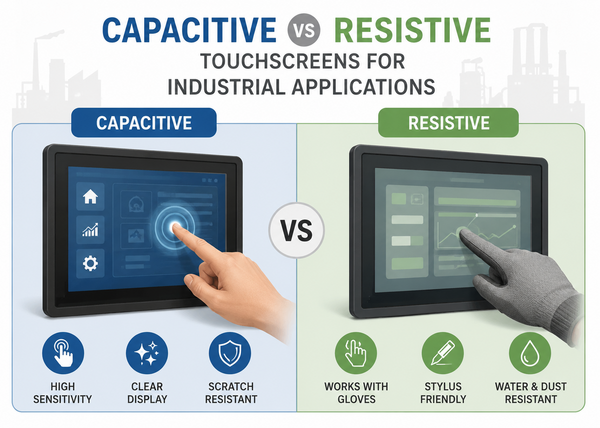
Capacitive vs Resistive Touchscreens for Industrial Applications
Modern industrial environments rely heavily on touchscreen technologies for machine control, process monitoring, operator interaction, and industrial visualization. From factory automation systems to warehouse management and SCADA interfaces, industrial touchscreen displays have become essential components of modern industrial infrastructure.
Capacitive vs Resistive Touchscreens for Industrial Applications
Modern industrial environments rely heavily on touchscreen technologies for machine control, process monitoring, operator interaction, and industrial visualization. From factory automation systems to warehouse management and SCADA interfaces, industrial touchscreen displays have become essential components of modern industrial infrastructure.
However, one of the most common questions businesses face when selecting an industrial display is:
Should you choose a capacitive or resistive touchscreen for your industrial application?
Both touchscreen technologies offer unique advantages, and the right choice depends on operational requirements, environmental conditions, and user interaction needs.
Understanding the differences between capacitive and resistive touchscreens can help manufacturers, OEMs, automation engineers, and system integrators choose the best solution for long-term industrial performance.
Why Touchscreen Technology Matters in Industrial Environments
Industrial touchscreen systems are commonly used in:
factory automation
SCADA systems
HMI interfaces
machine operator panels
industrial kiosks
logistics systems
medical equipment
transportation infrastructure
Unlike commercial environments, industrial applications often involve:
continuous 24/7 operation
dust exposure
vibration
harsh environments
glove operation
moisture and contaminants
Selecting the correct touchscreen technology directly impacts workflow efficiency, usability, and operational reliability.
What Is a Capacitive Touchscreen?
A capacitive touchscreen detects touch through the electrical conductivity of the human body.
These touchscreens use a conductive glass layer that responds when a finger or capacitive stylus touches the surface.
Capacitive touchscreens are commonly found in:
smartphones
tablets
modern industrial HMI systems
advanced operator interfaces
Industrial-grade capacitive touchscreens are increasingly used in smart manufacturing environments because they provide smooth and responsive interaction.
Advantages of Capacitive Touchscreens
Excellent Touch Sensitivity
Capacitive touchscreens provide:
fast response times
smooth user interaction
precise touch accuracy
multi-touch support
This improves operator efficiency and enhances modern industrial interfaces.
Better Visual Clarity
Because capacitive screens use glass-based technology, they often offer:
improved image quality
higher transparency
better brightness
clearer visualization
This is especially useful for industrial monitoring and SCADA applications.
Durable Surface Design
Industrial capacitive touchscreens typically feature strong glass surfaces that resist:
scratches
wear
surface damage
This helps improve long-term reliability in industrial environments.
Modern User Experience
Capacitive touchscreens support:
gesture controls
multi-touch functionality
smoother interface navigation
These features are ideal for advanced industrial automation systems and Industry 4.0 applications.
Limitations of Capacitive Touchscreens
Despite their advantages, capacitive touchscreens may not be suitable for every industrial environment.
Challenges may include:
limited performance with standard gloves
reduced usability with moisture on the screen
higher sensitivity to environmental conditions
Although industrial capacitive systems now support glove-friendly operation, some harsh environments still prefer resistive technology.
What Is a Resistive Touchscreen?
A resistive touchscreen works through pressure applied to the screen surface.
The touchscreen contains multiple layers that register input when pressure forces the layers to make contact.
Resistive touchscreens can be operated using:
fingers
gloves
styluses
tools
This makes them highly practical for rugged industrial environments.
Advantages of Resistive Touchscreens
Reliable Glove Operation
One of the biggest advantages of resistive technology is its ability to work effectively with:
industrial gloves
protective equipment
styluses
non-conductive objects
This is especially valuable in manufacturing and harsh industrial environments.
Better for Rugged Conditions
Resistive touchscreens are commonly used in environments involving:
dust
moisture
dirt
grease
industrial contaminants
Their pressure-based design makes them reliable under demanding conditions.
Cost-Effective Solution
In many industrial applications, resistive touchscreens provide a more affordable solution while still delivering reliable performance.
This makes them suitable for:
basic HMI systems
industrial control panels
machine interfaces
legacy industrial systems
Limitations of Resistive Touchscreens
Compared to capacitive touchscreens, resistive systems may offer:
lower image clarity
less responsive interaction
limited multi-touch support
reduced modern interface functionality
For advanced visualization environments, capacitive systems are often preferred.
Capacitive vs Resistive: Which Is Better for Industrial Applications?
The correct choice depends entirely on operational requirements.
Choose Capacitive Touchscreens If You Need:
modern HMI interfaces
smooth multi-touch interaction
advanced industrial visualization
high image clarity
smart factory applications
Industry 4.0 integration
Capacitive touchscreens are ideal for modern automation environments focused on advanced operator interaction and industrial visualization.
Choose Resistive Touchscreens If You Need:
reliable glove operation
rugged industrial performance
resistance to dust and moisture
basic industrial control systems
cost-effective touchscreen solutions
Resistive systems are often better for demanding industrial environments where practicality and durability are more important than advanced interface features.
Common Industrial Applications
Capacitive Touchscreen Applications
smart manufacturing systems
advanced HMI interfaces
industrial visualization platforms
SCADA dashboards
medical systems
industrial IoT applications
Resistive Touchscreen Applications
factory operator panels
warehouse systems
machine control interfaces
rugged industrial equipment
outdoor industrial environments
transportation systems
Important Factors to Consider Before Buying
Before selecting an industrial touchscreen system, businesses should evaluate:
operating environment
glove usage requirements
visualization needs
environmental exposure
interface complexity
long-term operational requirements
integration compatibility
Industrial applications vary significantly, so choosing the correct touchscreen technology is essential for long-term performance and workflow efficiency.
Why Industrial-Grade Touchscreens Matter
Consumer touchscreen systems are often unsuitable for industrial environments because they lack:
industrial durability
continuous operation support
environmental protection
rugged construction
Industrial-grade touchscreen systems are specifically designed for demanding industrial applications and provide:
longer operational lifespan
improved reliability
stable performance
better workflow efficiency
As automation and smart manufacturing technologies continue evolving, touchscreen systems will remain essential components of modern industrial infrastructure.
Choosing the right touchscreen technology helps businesses improve operational efficiency, operator interaction, and long-term industrial reliability.