
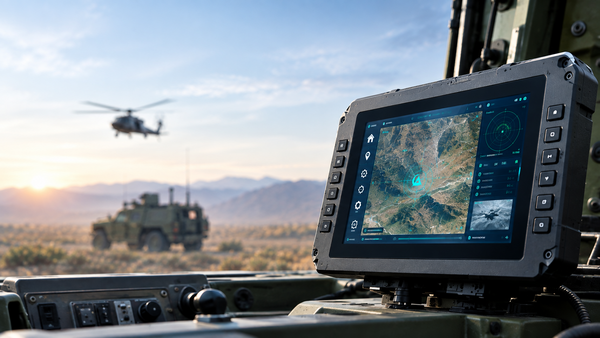
Military Technology Displays: How T&O Builds Custom Touch Panels
Military and defense electronics operate in conditions that would destroy a consumer or even a standard industrial display within days: extreme temperature swings, constant vibration, shock loads, sand and moisture ingress, and electromagnetic interference from nearby radios, radar, and weapons systems. A touchscreen that works perfectly in an office kiosk can fail completely on a vehicle dashboard, a field command post, or a shipboard console.
At T&O Electronic Solutions, custom touch display development for demanding sectors — including military and defense technology — is part of our core Display Solutions and Engineering Services offering. This article explains what actually separates a military-grade display from a commercial one, and how a structured, concept-to-production development process addresses those differences.
Why Military Technology Demands a Different Kind of Display
Commercial displays are engineered around cost and consumer usability. Military and defense displays are engineered around survivability and reliability under conditions the equipment cannot avoid — a vehicle in a desert, a vessel at sea, an aircraft cockpit, a field terminal in freezing rain. Two standards define most of this world:
- MIL-STD-810H — the current U.S. Department of Defense standard for environmental engineering considerations and laboratory test methods. It covers temperature extremes, humidity, vibration, shock, altitude, sand and dust, and salt fog, among other conditions.
- MIL-STD-461 — the standard governing electromagnetic interference (EMI) and electromagnetic compatibility (EMC), ensuring a display doesn't emit interference that disrupts nearby sensitive equipment, and isn't itself disrupted by the electromagnetic environment around it.
These aren't marketing checkboxes — they define measurable pass/fail test conditions, and a display intended for military technology applications needs to be engineered against them from the earliest design stage, not adapted afterward.
Key Requirements for Military-Grade Touch Displays
Sunlight readability and NVIS compatibility
Outdoor and vehicle-mounted displays must remain legible in direct sunlight, which typically means high-brightness panels, anti-reflective and anti-glare coatings, and optical bonding (eliminating the air gap between the touch sensor and the LCD to cut internal reflections and improve durability). Where a display will be used alongside night-vision goggles, it also needs NVIS (Night Vision Imaging System) compatibility — specific filtering so the screen doesn't wash out or interfere with the operator's night-vision equipment.
Wide operating temperature range and mechanical durability
Displays destined for military technology use are typically specified across extended temperature ranges well beyond commercial norms, and validated for shock, continuous vibration, thermal cycling, humidity, and — for maritime or coastal applications — salt fog resistance.
Sealed, rugged enclosures
IP-rated sealing (protection against dust and water ingress) is standard for field and vehicle-mounted equipment, paired with rugged mechanical housings that can absorb impacts without compromising the seal or the display underneath.
EMI/EMC shielding
Because military platforms pack dense electronics — radios, radar, weapons electronics, navigation systems — into confined spaces, displays need EMI shielding and controlled power conditioning so they neither emit nor absorb interference that could degrade nearby systems.
Touch technology suited to real operating conditions
This is where touch technology choice matters most. Operators frequently wear thick gloves, work in wet conditions, or need reliable input even with visible moisture or debris on the screen:
- Resistive touch (often 5-wire for durability) handles thick-glove operation and wet environments reliably, and tolerates unintentional contact well — useful where a stray touch shouldn't trigger a false input.
- Projected capacitive (PCAP) touch can also be tuned for gloved and wet-hand operation, but requires more careful hardware and touch-algorithm co-optimization to reject false touches from water droplets while still responding accurately to deliberate input.
Neither technology is universally “better” for military technology applications — the right choice depends on the specific operating environment, glove type, and expected exposure to moisture, which is exactly the kind of trade-off a custom OEM development process is built to resolve.
How T&O Approaches Custom Touch Panel Development
T&O's Display Solutions unit designs and manufactures display, IPC, and device systems across multiple industries, with Engineering Services covering hardware, software, and electronics development from concept and specification through to series production. For OEM customers building military and defense technology, that means the display isn't treated as an off-the-shelf component bolted onto a finished product — it's developed against the customer's actual mechanical, electrical, and environmental requirements from the start.
In practice, that development process typically follows a staged approach common across the display industry:
- Concept and specification — defining the operating environment (temperature range, expected shock/vibration, sealing requirements, EMI environment), the touch technology best suited to how operators will actually use the device (gloved, wet-hand, bare-hand), and the optical requirements (brightness, NVIS compatibility, viewing angle).
- Design and engineering verification — early-stage validation of critical parameters before the design is locked, catching issues in optical performance, EMI behavior, or mechanical fit while changes are still inexpensive to make.
- Design verification testing — full environmental and mil-spec-aligned testing against the finalized design, confirming the display performs to specification under the actual conditions it was engineered for.
- Production verification — validating that the manufacturing process itself produces consistent, reliable units at volume, not just a single working prototype.
This staged process is standard practice for rugged and mil-spec-aligned display development, and it's the same discipline T&O applies across its OEM display projects — reducing the risk of costly redesigns after a customer has already committed to a platform.
Capacitive vs. Resistive Touch for Military Applications
We've covered the general capacitive-vs-resistive trade-off in detail in a separate article (Capacitive vs Resistive Touchscreens for Industrial Applications), and the same underlying physics applies in military technology contexts — just with higher stakes. In short: resistive touch remains a strong choice where gloved operation and unpredictable moisture are a given and false-touch rejection matters more than multi-touch gestures; capacitive touch offers a more modern, responsive feel but needs more engineering effort to perform reliably in the same conditions. A custom development process lets this decision be made against the actual use case, rather than forcing a standard commercial panel into a role it wasn't designed for.
Conclusion
Military technology displays succeed or fail on details that never show up in a datasheet's headline specs: how a screen behaves with a wet, gloved finger on it at −20°C, whether it stays legible in direct desert sunlight, and whether it can sit two feet from an active radar system without glitching. Getting those details right requires treating the display as an engineered subsystem, not a commodity part — which is the approach T&O brings to custom touch panel projects for industry, and for military and defense technology applications specifically.
Frequently Asked Questions
What makes a display “military-grade” instead of just industrial-grade?
Military-grade displays are engineered and tested against defense-specific standards — most commonly MIL-STD-810H for environmental durability (temperature, shock, vibration, humidity, dust) and MIL-STD-461 for electromagnetic interference and compatibility. Industrial displays are built tough, but not necessarily validated against these specific military test methods and thresholds.
Is capacitive or resistive touch better for military applications?
Neither is universally better — it depends on the operating conditions. Resistive touch generally handles thick gloves, moisture, and accidental-touch rejection more predictably. Capacitive touch can be engineered for similar conditions but requires more hardware and software tuning to reject false touches from water while remaining responsive.
What is NVIS compatibility, and does every military display need it?
NVIS (Night Vision Imaging System) compatibility means a display's backlighting and coatings are engineered not to interfere with night-vision goggles. It's essential for cockpit, vehicle, and field displays used alongside night-vision equipment, but not every military display application requires it — it depends on the specific deployment scenario.
Why does EMI/EMC shielding matter so much in military electronics?
Military platforms concentrate large amounts of sensitive electronics — radios, radar, navigation, weapons systems — in relatively small spaces. A display that emits electromagnetic interference can degrade nearby systems, and a display that isn't shielded against external interference can malfunction. MIL-STD-461 testing exists specifically to catch these problems before deployment.
Can an existing commercial or industrial display be ruggedized for military use, or does it need to be custom-built?
It depends on how far the requirements diverge from the original design. Sometimes an existing display platform can be adapted with a new enclosure, sealing, and coatings. But when requirements include specific EMI shielding, NVIS compatibility, or extreme temperature ranges, a custom-engineered display — built against the actual specification from the start — is usually the more reliable and cost-effective path over the product's lifecycle.
How long does custom military display development typically take?
Timelines vary significantly by complexity, but a staged process — concept and specification, engineering verification, design verification testing, and production verification — is standard practice, since it catches design issues early rather than after tooling and manufacturing are locked in. Exact timelines depend on the specific requirements of each project.
Does T&O manufacture displays specifically certified for military use?
T&O's Display Solutions and Engineering Services units develop custom touch display and device systems for OEM customers across several industries, including military and defense technology, following industry-standard development and validation practices. For specific certification requirements on a given project, T&O works directly with the customer to define and validate against the applicable standards for that application.
What industries besides military and defense does T&O serve with custom displays?
T&O serves Industry, Food, Military, and Medical technology sectors with custom display, embedded computing, and engineering solutions, alongside process technology and air quality measurement systems.