
Industrial PC Failing Every Few Months? The Fan Is Probably the Problem
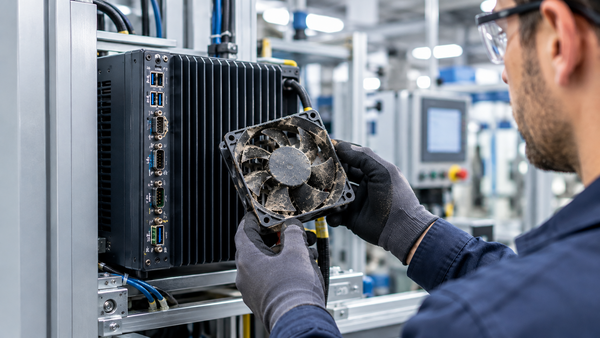
If your industrial PC keeps crashing, freezing, or dying every few months no matter how many times it gets replaced, the most likely cause isn't the motherboard, the power supply, or "bad luck" — it's the cooling fan. In dusty, hot, or vibration-heavy environments, fans are usually the first component to fail, and when they fail, they take the rest of the system down with them. The fix in most cases is a fanless industrial PC, a design that removes the fan entirely and cools the system passively instead.
If your industrial PC keeps crashing, freezing, or dying every few months no matter how many times it gets replaced, the most likely cause isn't the motherboard, the power supply, or "bad luck" — it's the cooling fan. In dusty, hot, or vibration-heavy environments, fans are usually the first component to fail, and when they fail, they take the rest of the system down with them. The fix in most cases is a fanless industrial PC, a design that removes the fan entirely and cools the system passively instead.
Why does my industrial PC keep failing?
In most repeat-failure cases, the pattern is the same: a fan bearing wears out, slows down, or seizes; the system's internal temperature climbs past its safe operating range; and the PC either shuts down, throws random errors, or suffers permanent damage to the CPU, storage, or power components. Because the fan is a moving mechanical part in an environment full of dust, heat, and vibration, it is statistically the component most likely to wear out first — well before the electronics around it would fail on their own.
How exactly does a cooling fan cause an industrial PC to fail?
A fan has bearings and moving blades, both of which degrade with continuous operation, heat, and mechanical stress. As a fan bearing wears, it moves less air; as it moves less air, internal temperatures rise; as temperatures rise, other components run hotter than they were designed for and fail faster. It's a chain reaction that starts with one part rated for a few years of continuous duty in ideal conditions — conditions a factory floor rarely provides.
Why is dust so damaging to fan-cooled PCs specifically?
A cooling fan doesn't just fail on its own — it actively pulls the environment into the machine. Every fan-cooled enclosure has intake and exhaust vents, and every one of those vents is also an entry point for dust, metal shavings, moisture, and airborne contaminants. That debris settles on circuit boards and inside the fan itself, accelerating both the fan's failure and, over time, the electronics'. In food production, machining, or outdoor environments, this isn't a rare edge case — it's the normal operating condition.
What is a fanless industrial PC, and how is it different?
A fanless industrial PC removes the fan altogether and instead uses a sealed, heat-conductive enclosure — typically an aluminum chassis — to draw heat away from the CPU and other components and dissipate it passively through the case itself. Because there's no fan, there's no moving part to wear out, and because the enclosure can be fully sealed, dust, moisture, and contaminants have no path inside. This is also why fanless designs are the standard choice anywhere a sealed or washable enclosure is a hard requirement, such as food production or medical environments.
How much more reliable is a fanless industrial PC, really?
Manufacturers commonly report Mean Time Between Failure (MTBF) figures in the range of 250,000+ hours for fanless industrial PCs under their rated operating conditions, compared with roughly 20,000 hours typically cited for standard fan-cooled desktop-class systems. That's a meaningful gap, though it's worth treating these as manufacturer-published figures rather than independently audited numbers — actual results vary with the specific enclosure, environment, and duty cycle. What holds consistently true across independent engineering sources is the underlying mechanism: removing the one continuously-moving mechanical part removes the most common single point of failure.
When does it make sense to switch to a fanless industrial PC?
A fanless design is worth the switch when any of the following applies to your setup: the PC has failed more than once in a similar way, it operates in a dusty, humid, or high-vibration environment, it needs to survive washdown or sanitizing (food, pharma, medical), it runs in a temperature-controlled or extreme-temperature enclosure with no room for airflow, or it needs to run unattended for years without scheduled maintenance. If none of those apply — for example, a climate-controlled office server room — a standard fan-cooled system may still be the more cost-effective choice.
What should you look for when choosing a fanless industrial PC?
Not all fanless PCs are built for the same conditions. Look for a stated operating temperature range that matches your actual environment (not just a "wide temperature" marketing claim), an enclosure rating (IP65/IP66 or similar) if washdown or dust exposure applies, and — for demanding or non-standard applications — the option for custom engineering rather than a fixed catalog unit. A rugged, mil-spec-aligned, or medical-grade build isn't the same as a general-purpose "fanless" label, and the difference shows up in the field, not on the spec sheet.
If your application doesn't fit a standard off-the-shelf configuration, T&O Electronic Solutions engineers fanless and rugged industrial PCs to spec — from concept through series production — for Industry, Food, Military, and Medical applications. Request a Custom Quote to talk directly with the engineering team behind the product.
FAQs
What is a fanless industrial PC?
A fanless industrial PC is a computer built without a cooling fan, relying instead on a sealed, heat-conductive enclosure to dissipate heat passively. This removes the most common mechanical failure point and allows the unit to be fully sealed against dust and moisture.
How long do fanless industrial PCs last compared to standard PCs?
Manufacturers commonly cite MTBF figures of 250,000+ hours for fanless industrial PCs under rated conditions, versus roughly 20,000 hours for standard desktop-class PCs — though real-world lifespan depends heavily on the specific unit and operating environment.
Can fanless industrial PCs handle high-temperature or extreme environments?
Yes — most fanless industrial PCs are rated for operating ranges around −20°C to +70°C or wider, which is why they're standard in outdoor, industrial, and vehicle-mounted applications. Always check the specific unit's rated range against your actual environment rather than assuming a general "wide temperature" claim covers your use case.
Are fanless industrial PCs more expensive than fan-cooled models?
Typically yes, upfront — the sealed enclosure and passive cooling design cost more to engineer and manufacture than a standard fan-cooled unit. In environments where fan failure causes repeat downtime, however, the total cost of ownership usually favors the fanless option once replacement units, technician visits, and production downtime are factored in.
Do fanless industrial PCs need any maintenance?
Far less than fan-cooled systems. Without a fan, there's no filter to clean or bearing to replace — most maintenance needs are limited to periodic inspection of the sealed enclosure and connectors.
Can I get a custom fanless industrial PC built for my specific application?
Yes. Rather than adapting a general catalog unit, T&O Electronic Solutions designs fanless and rugged industrial PCs around your mechanical, electrical, and environmental requirements — from initial specification through series production.