
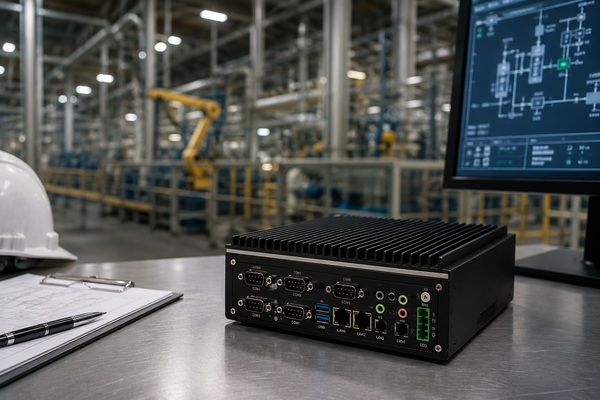
Embedded Industrial PCs for Plant Engineering: What to Look for in 2026 and How T&O Solves It
Plant engineers today face a harder version of an old problem: keep production running reliably, in dusty and demanding environments, while equipment gets smarter and more data-hungry every year. The computer hardware sitting inside your control cabinets and machines has to keep up — without adding new points of failure.
If you're evaluating industrial PCs for a plant engineering application, here's what's actually changed recently, what to watch for, and how to choose the right solution.
Plant engineers today face a harder version of an old problem: keep production running reliably, in dusty and demanding environments, while equipment gets smarter and more data-hungry every year. The computer hardware sitting inside your control cabinets and machines has to keep up — without adding new points of failure.
If you're evaluating industrial PCs for a plant engineering application, here's what's actually changed recently, what to watch for, and how to choose the right solution.
What's changing in Embedded Industrial PCs for Plant Engineering right now
AI has moved from the cloud to the plant floor. Industrial embedded PCs increasingly ship with built-in AI accelerators (NPUs), allowing equipment to run predictive maintenance and real-time fault detection locally — without sending sensitive production data offsite or depending on cloud latency. For plant engineers, this means catching a failing component before it causes downtime, not after.
Modular platforms are replacing rigid, one-off hardware builds. Standardized I/O boards and stackable compute cores let manufacturers adapt the same base hardware across multiple machines instead of engineering a new one-off solution for every application. This shortens time-to-market and simplifies long-term spare-parts planning.
Fanless, sealed designs remain the standard, not the exception. Especially in IP65-rated enclosures, sealed and fanless housings continue to be the default expectation for dusty, wet, or high-vibration plant environments — fans are moving parts, and moving parts fail.
Supply chain volatility hasn't fully resolved. Lead times of 8–12 weeks for certain processor families remain common in 2026. This makes supplier reliability and stock availability just as important a purchasing factor as raw specifications.
What this means for your plant engineering project
If you're specifying or replacing industrial PC hardware for a plant application, the practical takeaways are:
Prioritize fanless, sealed housings if your environment involves dust, moisture, or vibration.
Ask whether the hardware platform is modular/reconfigurable — this protects you from re-engineering everything when requirements shift.
Consider whether AI-based monitoring is worth building in now, even if you don't need it on day one — retrofitting it later is harder.
Choose a supplier who can talk you through form factor options (DIN rail, panel-mount, box PC, articulated arm) rather than pushing a single fixed product.
Factor in lead time and supply reliability, not just unit price.
How T&O Electronic Solutions addresses this
T&O offers embedded and integrable industrial PCs specifically built for plant engineering applications, in compact, flat, fanless housings designed to match your performance and space requirements — rather than forcing a one-size-fits-all product.
Your challenge | How T&O helps |
|---|---|
Needs a PC that survives plant conditions long-term | Fanless, sealed housings built for continuous industrial operation |
Unsure which form factor fits the control cabinet | Multiple mechanical options: embedded PCs, box PCs, DIN rail IPCs, panel-mount, articulated arm |
Worried about being locked into a rigid standard product | Custom housing design and configuration tailored to your specification |
Needs support beyond the initial purchase | Full engineering lifecycle: Consulting & Specification → Development → Series Production & Support |
Concerned about single-supplier risk during shortages | Backed by an established engineering and production process, not a single fixed SKU |
If you're currently specifying hardware for a plant engineering application, it's worth a conversation before you lock in a design — getting the form factor and housing decision right up front avoids expensive rework later.
Get in touch with our engineering team →
Frequently Asked Questions
What is an embedded industrial PC, and how is it different from a regular PC?
An embedded industrial PC is a ruggedized computer built directly into machinery or control systems, engineered for continuous operation in harsh conditions — dust, vibration, and temperature extremes. Unlike a consumer PC, it isn't designed to survive a plant floor, and typically fails faster in these environments.
Why does a fanless design matter for plant engineering equipment?
Fans are moving parts, and moving parts fail — especially when exposed to dust or debris. A fanless, sealed design means fewer breakdowns, lower maintenance costs, and better protection in dirty or high-vibration environments, which is critical for equipment that needs to run continuously.
Can an embedded PC handle AI or predictive maintenance workloads?
Increasingly, yes. Many current-generation embedded PCs now include AI acceleration hardware (NPUs) that can process sensor data locally and flag equipment issues before they cause failures — without needing a separate server or cloud connection.
How do I know what size or form factor I need for my control cabinet?
This depends on your available enclosure space, required I/O, and mounting method — DIN rail, panel-mount, or box PC. A proper needs assessment based on your specific cabinet and application avoids costly rework later, rather than picking from a generic catalog.
What happens if my supplier can't deliver on time due to chip shortages?
This remains a real risk in 2026, with some processor families still seeing 8–12 week lead times. Working with a supplier who maintains stock and offers engineering flexibility — rather than being locked into one fixed component — significantly reduces this exposure.
Can I get a custom housing instead of an off-the-shelf design?
Yes. Rather than forcing you into a rigid standard product, many providers — including T&O — offer custom housing design and configuration built around your specific requirements.
Is a modular industrial PC platform worth the extra consideration over a fixed design?
For most plant engineering applications, yes. A modular platform means the same base hardware can be reconfigured or adapted as requirements evolve, instead of requiring a full re-engineering effort every time specifications change.
T&O Electronic Solutions designs and delivers embedded industrial PCs and display solutions for plant engineering, automation, machine tools, food industry, military technology, and OEM applications. Explore our display solutions →